




Getting our priorities right
Imagine a stage where a play is being enacted. There are five actors on stage, each acting according to their script. If the actors follow their respective scripts, the drama will go smoothly. But suppose one actor forgets his lines and says something else, what will the others do? They will not stop and say, “Why are you saying this...” The play has to go on, so they will stick to their lines, which can guide the other actor to what he needs to do or say next. When every actor focuses on their part, their lines, all goes well, but if the actors start correcting each other on stage, there will be chaos. This holds a lesson for us.
Do we focus on our part and our lines in real life? If there is an argument at home, with your spouse, note the kind of thoughts you have. “They should have done that...”, “They should not have spoken like that....” We get busy writing the other person’s script in our mind, and they are doing the same for us. Since most of the time we are thinking about what the other person should be doing or saying, we forget to write our own script: ‘What is the best way to look at this situation... what words should I choose to speak right now, when my spouse is disturbed?’ All of us know the answers to these questions, but our mind is too busy with what the other person should be saying or doing. Why? Because of our attachment to the image of what I am and what the other person should be like: ‘My husband should be like this... my child should be like this....’ But remember, husband, child, parent, sibling - these are merely roles. Who is playing the role? The soul. Recognising this fact is the first step towards changing the way we see our relationships.
I may know what is good for the other person, but I must remember that like me they are a soul on a journey of their own. This shift in our consciousness will change our way of thinking. What happens when we are not soul conscious? Suppose we go to our workplace. At the gate we see the security guard, and then the person at the front desk greets us. Later we see the manager, and have a meeting with the CEO. How do we behave with these people? Are we the same with each of them? No. When I am with the CEO there is the feeling of being a subordinate, whereas I feel superior to the security guard. Why? Because I am identifying myself and others by the roles we are playing. When I see myself and others as souls, the soul’s original qualities - purity, peace, love, truth - will inform my behaviour.
If I am role conscious, I may open the door and pull back the chair for my boss, but I may not be having the best thoughts or feelings for them. True respect is when my thoughts for the other person are pure. Then I will radiate positive vibes. The first step to doing that is becoming soul conscious. The soul is the actor playing a role. Once I start seeing myself and others with this awareness, a lot will start changing in life. I will neither feel inferior nor superior to anyone. I will also not seek validation or approval from others. With regular practice, the awareness of being a soul will become strong and I will naturally operate on the basis of the soul’s original qualities. Then I will cease to be affected by the behaviour of others.
We can strengthen the awareness of being a soul in simple ways. The next time someone asks you your age, say you are ageless. Your body may be 30, 50, or 60 years old, but the soul is eternal. You can ask yourself, if I the soul am eternal, where was I before I was born in this body? I was in another body, with a different family, maybe in a different country and culture. And where was I before that? In another body, again a different family, a different environment. Reflecting like this helps us understand that we are much more than what we appear to be in the present, and the same is true for other people.
When someone leaves their body, people remark philosophically that the person came into this world empty-handed and left empty-handed. That is not true, because it applies only to material things. When I the soul leave my body, I will leave behind all my possessions, relationships, the titles I acquired.... What goes with me are my karma and ‘sanskars’ - they decide, to a large extent, the quality of my experiences in future lives.
But we tend to pay more attention to the things we will leave behind upon death. Becoming soul-conscious changes that and we get our priorities right. We take care that while working, raising a family, and achieving our other goals, our karma and ‘sanskars’ are right. Then we will not get stressed by work, or use anger to get things done. The thoughts we repeatedly create, the corresponding feelings that arise, and the way we function and relate to others, all go into forming our ‘sanskars’ - the blueprint for the soul’s future actions and experiences. When we see to it that our karma and ‘sanskars’ are right, we ensure that our destiny will be good.
B.K. Shivani is a well-known motivational speaker and Rajyoga teacher.
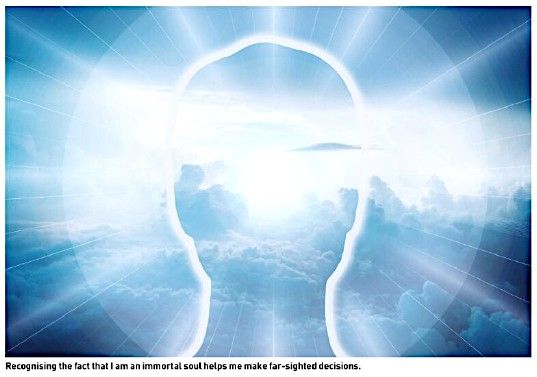
Recognising the fact that I am an immortal soul helps me make far-sighted decisions.